


PREP Program
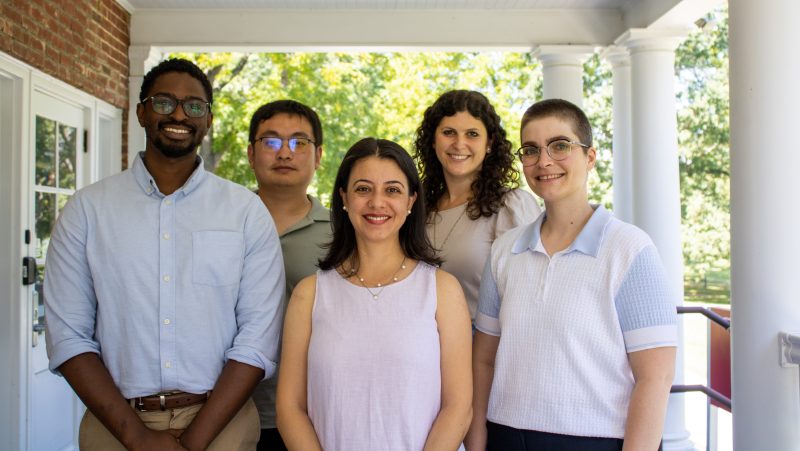
Preparing Your Research for an Extramural Proposal program
The Institute for Society, Culture and Environment’s Preparing Your Research for an Extramural Proposal (PREP Program) is a selective, cohort-based research-development program designed to help Virginia Tech faculty strengthen promising research and scholarship and position their projects for competitive external funding. Participants will work toward a substantially revised proposal narrative, an identified funding opportunity or sponsor strategy, and a realistic plan for external submission.
- Applications due: Dec. 4, 2026
- Notification of acceptance: Dec. 16, 2026
- Program sessions (dates to be determined): Spring 2027
Program highlights:
- Up to eight faculty participants selected from across Virginia Tech
- Four 90-minute working sessions focused on developing and refining external funding proposals
- Individualized project planning, funding strategy guidance, and confidential expert review
- $1,000 in research-development funds upon successful completion of program requirements
Eligibility and research focus:
PREP is open to faculty from any Virginia Tech college or campus. Projects must meaningfully incorporate social science or humanities perspectives, theories, or methods, and interdisciplinary proposals are highly encouraged. Applicants may be developing an initial concept or working on an early proposal draft. An identified funding sponsor is encouraged but not required.
Projects should align with one or more of the institute’s thematic areas:
- Healthspan and Human Development
- Risk and Resilience
- Communities and Environments
- Policies and Practices
Applicants should review the full Call for Applications for eligibility, program expectations, and submission instructions.
Questions and application submissions: Yancey Crawford (yanceyc3@vt.edu)

- Jenn Engelke, assistant professor of landscape architecture in the School of Design, "From Environmental Knowledge to Action: Experiential Learning for Systems Thinking and Ecological Literacy."
- Lia Kelinsky-Jones, research assistant professor of agriculture, leadership, and community education in the College of Agriculture and Life Sciences, "Conceptual and Relational Evidence Use in Virginia School District Decisions About Freshly Prepared Meals."
- Pipiet Larasatie, extension specialist and assistant professor of sustainable biomaterials in the College of Natural Resources and Environment, "Building a Climate‑Resilient Future: U.S.–Japan Collaboration on Transparent Sustainability and Social Impact Metrics for Mass Timber Construction."
- Gonzalo Munoz-Vera, assistant professor of architecture in the School of Architecture, "Architectural Discourse in Print: The Virginia Record’s Impact in Shaping (and Representing) the Built Environment (1982-1989)."
Learn more about the 2026 PREP Program recipients and their research.

- Austin Gray, assistant professor of Biological Sciences in the College of Science, "Assessing the Occurrence and Impact of CECs in Floodwaters in Disadvantaged Communities in Hampton Roads: An Ecological and Environmental Justice Approach"
- Isabel Prochner, assistant professor of Industrial Design in the College of Architecture, Arts & Design, "Design-driven methods and technologies enabling more effective, safe, and comfortable chest binding for transgender people"
- Rosanna Breaux, assistant professor of Psychology in the College of Science, "Validation of the Parent Emotion Socialization in Daily Life Measure"
- Zehra Gulseven, assistant professor of Psychology in the College of Science, "Examining Prosocial Development from Middle Childhood through Adolescence"
- Zhenshan Chen, assistant professor of Agricultural and Applied Economics in the College of Agriculture and Life Sciences, "Fair and Viable Carbon Markets for Farmers: Empowering Sustainable Agriculture Practitioners"
To read the VT News article, click here.

- Sweta Baniya, assistant professor of English in the College of Liberal Arts and Human Sciences, “Compounding Crisis and Communication: Strengthening Transnational Disaster Response and Community Resilience via Social Justice Oriented Crisis Communication”
- Rachel Cheng, assistant professor of food science and technology in the College of Agriculture and Life Sciences, “Case-control Study of Foodborne and Non-Foodborne Acquired Salmonellosis in Children”
- Shaddi Hasan, assistant professor of computer science in the College of Engineering, “Advancing Digital Equity through Scalable Techniques for Improving Broadband Data Collection and Integrity”
- Rachelle Kuehl, research scientist for the Center for Rural Education, “Teaching Race in Rural Places: Investigating Contextualized Challenges, Successes, and Solutions in Contentious Times”
- Jessica Rich, research assistant professor for the Center for Coastal Studies, “A Comparative Study of Environmental Decision-Making in Coastal Virginia and Greenland”
- Ruichuan Zhang, assistant professor for the Myers-Lawson School of Construction in the College of Engineering, “Assessing Adaptive Buildings for Inclusive Disaster Response”
To read the VT News article, click here.

- Elinor Benami, assistant professor of agricultural and applied economics in the College of Agriculture and Life Sciences, “Reassessing drought indicators used to finance relief payments in the U. S. Crop Insurance Program.”
- Heather Davis, assistant professor of psychology in the College of Science, “Investigating shame as a mechanism underlying eating disorder comorbidity.”
- Junghwan Kim, assistant professor of geography in the College of Natural Resources and Environment, “Assessing urban walkability with an artificial intelligence (AI) method: A case study in small-sized U.S. cities.”
- Karin Kitchens, assistant professor of political science in the College of Liberal Arts and Human Science, “Identifying variation in juvenile sentencing.”
- Michael G. Sorice, associate professor of forest resources and environmental conservation in the College of Natural Resources and Environment, “Ecosystem stewardship as a policy target: Cultural expectations for private lands in the United States.”
- Hannah M. Sunderman, assistant professor of agricultural, leadership, and community education in the College of Agriculture and Life Sciences, “An intersectional approach to leader(ship) identity development through meaning making.”
- Clara H. Suong, assistant professor of political science in the College of Liberal Arts and Human Science, “Popular but unimportant? Power and language in digital diplomacy.”
To read the VT News article, click here.